
Choosing where to put your money shouldn’t feel like a part-time job. Yet between confusing fee schedules, teaser interest rates that quietly disappear after three months, and hundreds of banks all claiming to be “the best,” most Americans end up banking wherever they happened to open their first account — often paying for it in fees they don’t notice and interest they never earn.
BankNavigatorr exists to fix that. We’re an independent research site built around one mission: rank, compare, and explain U.S. bank accounts — checking, savings, CDs, online banks and business accounts, so you can make a confident decision in minutes instead of hours. No jargon, no sales pitch, no pretending every account is “the best” for every person. Just clear, evidence-based rankings organized around what you’re actually trying to do with your money.
Below is a complete tour of what you’ll find on the site.
Why BankNavigatorr Is Different
Most banking comparison sites fall into one of two traps. Either they’re thin affiliate pages recycling the same five bank names with no real analysis, or they’re dense financial-advisor content that assumes you already understand APY, FDIC pass-through insurance, and ACH settlement windows. We built BankNavigatorr to sit in between: rigorous enough to trust, simple enough to actually use.
Every ranking on this site follows the same standards:
- We verify, not assume. Rates, fees, and bonus terms are checked against each bank’s current disclosures before publication, and we note clearly when a figure is variable and likely to change.
- We explain the “why,” not just the “what.” A ranking without reasoning is just a list. We break down exactly which requirements you need to meet, which fees to watch for, and who each account genuinely fits — not just who it’s marketed to.
- We flag the fine print. Teaser rates, balance caps, monthly activity requirements, and hidden fees get called out explicitly, because that’s usually where the real cost of a “free” account hides.
- We stay current. Interest rates move with the Federal Reserve, banks change their bonus offers constantly, and products get discontinued. We revisit our rankings regularly rather than publishing once and letting them go stale.
- We’re upfront about how we make money. BankNavigatorr has no affiliate relationships with any bank, and no provider pays to be included or ranked. The site is supported by ads served by Google AdSense.
We are not a bank, financial advisor, or broker, and nothing on this site is personalized financial advice. We’re a research and comparison resource — the decision, and the responsibility for confirming current terms directly with any provider, is always yours.
What You’ll Find on BankNavigatorr
Our content is organized into five core sections, each built around a different banking need.
Best Bank Accounts — Find the Right Everyday Account
This is where most people should start: a complete breakdown of checking and everyday banking options, organized by who you are and what you need, rather than a single generic “top 10” list.
Inside this section, you’ll find in-depth guides covering:
- Best Credit Union Bank Account in 2026
- Best Joint Bank Account for Couples in 2026

- Best Bank Account for Teens in 2026

- Best Bank Account for Seniors in 2026

- Best Bank Account for Students in 2026

- Best Bank Accounts for Bad Credit in 2026 (Including No-ChexSystems Options)
- Best Bank Accounts of 2026: Top Picks for Every Need
Whatever your starting point — rebuilding your banking history, opening your very first account, or simply tired of your current bank’s fees — this section is built to get you to a confident answer fast.
High-Yield Savings & CDs — Make Your Money Actually Earn Something
The single biggest, easiest financial upgrade most people never make: moving savings out of an account earning 0.01% and into a high-yield account earning 3% or more. This section is dedicated entirely to helping you find that upgrade and use it well.
Here’s what’s covered
- APY vs. Interest Rate: What’s the Difference?
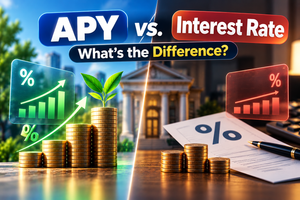
- Best CD Rates of 2026
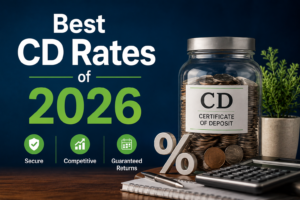
- Best High-Yield Savings Account of 2026

If your money is currently sitting in a low-interest account out of habit rather than choice, this is the section that will show you exactly how much that’s costing you — and what to do about it.
Online & Digital Banks — Banking Without the Branch
Online banking isn’t a niche alternative anymore — for a huge share of Americans, it’s the default. This section helps you navigate an increasingly crowded field of neobanks, digital-first banks, and fintech apps, all competing for your business with different combinations of rate, features, and simplicity.
Topics covered include:
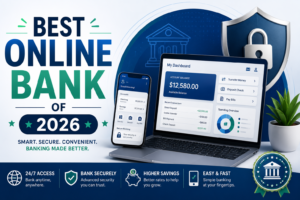
Whether you’re switching to digital banking for the first time or optimizing an app-based relationship you already have, this section covers the decision points that actually matter.
Business Bank Accounts — Banking Built for How You Actually Work
A business bank account is not a one-size-fits-all decision — a venture-backed startup, a solo freelancer, an e-commerce seller, and a nonprofit all have fundamentally different needs, even though they’re often lumped together in generic “best business account” roundups. This section breaks the decision apart by business type.
Inside, you’ll find:
- Best Business Bank Account for Nonprofits in 2026
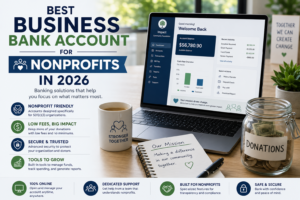
- Best Business Bank Account With No Fees in 2026

- Best Business Bank Account for Startups in 2026

- Best Business Bank Account of 2026

If you run any kind of business — from a single-member LLC to a multi-program nonprofit — this section is built to match your specific operational reality, not a generic template.
Banking Basics — Understand How Your Money Actually Works
Choosing the right account is easier when you understand the rules behind it. This section explains the essentials of U.S. banking in plain English — how FDIC insurance protects your deposits, what APY really means, how to check your ChexSystems report, how to switch banks without missing a payment, and how to avoid the fees that quietly eat into your balance. Every guide links to official sources such as the FDIC, CFPB and NCUA.
Inside, you’ll find:
- APY vs. Interest Rate: What’s the Difference?
- How FDIC Insurance Works: What’s Covered and What Isn’t
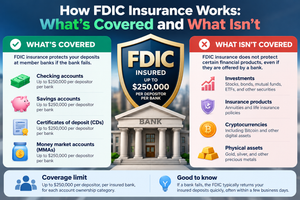
If you’re new to banking in the U.S., or just want to make sure you’re not missing something important, this is the best place to start before comparing specific accounts.
How to Use This Site
We’d suggest starting with whichever section matches your most immediate need, rather than trying to read everything at once:
- Opening your first account, or fixing a bad banking situation? Start with Best Bank Accounts.
- Have money sitting in a low-interest account doing nothing? Start with High-Yield Savings & CDs.
- Thinking about switching to a digital-first bank, or already have one and want to optimize it? Start with Online & Digital Banks.
- Running a business, freelancing, or managing a nonprofit? Start with Business Bank Accounts.
- New to U.S. banking, or want to understand the rules first? Start with Banking Basics.
Every guide on this site follows the same format: a quick-answer comparison table up top for readers in a hurry, followed by a detailed breakdown of each option, an explanation of our methodology, a “how to choose” section matched to different reader situations, and a frequently-asked-questions section addressing the specific concerns people actually have before opening an account.
A Final Word on Trust
Banking decisions are personal, and what’s “best” always depends on your specific situation — your balance, your habits, your risk tolerance, and what you actually need your money to do. Our job isn’t to tell you there’s one right answer. It’s to lay out the real options clearly enough, and honestly enough, that you can make that decision yourself with confidence.
Rates and terms in the financial industry change constantly, so we treat every ranking on this site as a living document, not a one-time publication. If something looks out of date, or if you have a suggestion for a comparison we haven’t covered yet, we want to hear about it — this site is built to stay useful, not just to launch well.
Welcome to BankNavigatorr. Let’s find the right account for you.
BankNavigatorr is an independent research site supported by advertising. We have no affiliate relationships with any bank or financial provider, and no provider pays to be included or ranked.