
Facts checked against FDIC and NCUA sources on October 20, 2026.
When you put money in a U.S. bank, you’re protected by one of the strongest guarantees in personal finance: federal deposit insurance. But the protection has limits, and plenty of people don’t know exactly what’s covered, what isn’t, or how to protect balances above the limit. This guide explains how FDIC insurance (and its credit union equivalent, NCUA insurance) works in plain English.
Table of Contents
What Is FDIC Insurance?
The Federal Deposit Insurance Corporation (FDIC) is an independent U.S. government agency that insures deposits at member banks. If an FDIC-insured bank fails, the FDIC makes sure depositors get their insured money back. You don’t need to apply or pay for it: if you open a deposit account at an FDIC-insured bank, you’re covered automatically.
How Much Is Covered?
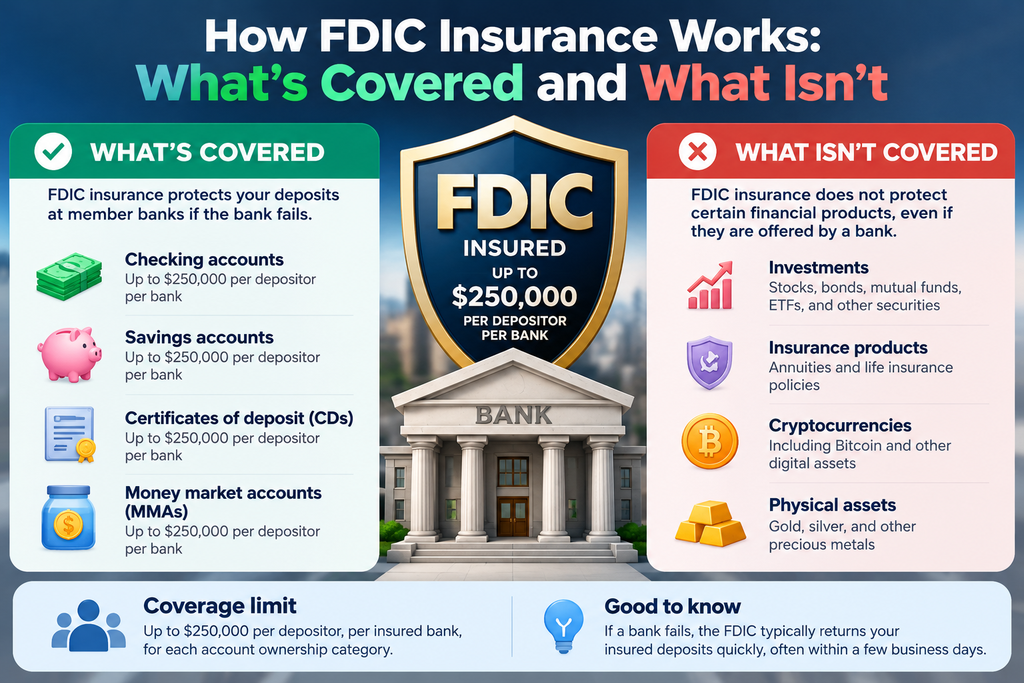
The standard coverage is $250,000 per depositor, per insured bank, for each account ownership category, according to the FDIC. Each part of that sentence matters:
- Per depositor: the limit applies to each person, not each account. Three savings accounts in your name at the same bank are added together.
- Per insured bank: money at two different FDIC-insured banks is insured separately, so $250,000 at each bank is fully covered.
- Per ownership category: different ways of owning money — for example single accounts, joint accounts, certain retirement accounts such as IRAs, trust accounts and business accounts — each get their own coverage at the same bank.
A quick example
A married couple banks at one FDIC-insured bank. Each spouse has an individual savings account, and they share a joint account:
| Account | Ownership category | Insured up to |
|---|---|---|
| Partner A’s savings | Single | $250,000 |
| Partner B’s savings | Single | $250,000 |
| Joint checking and savings | Joint (each co-owner insured up to $250,000) | $500,000 |
| Total at one bank | $1,000,000 |
Rules for trusts and some other categories are more complex. To check your own situation, use the FDIC’s Electronic Deposit Insurance Estimator (EDIE), linked from its Understanding Deposit Insurance page.
What FDIC Insurance Covers — and What It Doesn’t
The FDIC insures deposits. According to the FDIC, that includes:
- Checking accounts and NOW accounts
- Savings accounts
- Money market deposit accounts
- Certificates of deposit (CDs)
- Cashier’s checks, money orders and other official bank items
It does not cover:
- Stocks, bonds, mutual funds and annuities
- Life insurance policies
- U.S. Treasury bills, bonds and notes (these are backed by the U.S. government in a different way)
- Municipal securities
- Crypto assets
- Safe deposit boxes and their contents
This matters because many banks also sell investments. A money market fund bought through your bank’s brokerage arm is an investment, not an FDIC-insured money market deposit account.

Credit Unions: NCUA Share Insurance
Credit unions aren’t covered by the FDIC. Instead, federally insured credit unions are covered by the National Credit Union Share Insurance Fund, administered by the National Credit Union Administration (NCUA). According to the NCUA, the fund is “backed by the full faith and credit of the United States” and covers individual accounts up to $250,000 per member, with joint accounts and IRA/KEOGH retirement accounts insured separately.
One caveat: a small number of state-chartered credit unions use private insurance instead. Those policies are not backed by the U.S. government. You can confirm a credit union’s status with the NCUA’s Credit Union Locator.
Fintech Apps and “Up to $5 Million” Coverage
Many apps say your money is “FDIC-insured” even though the app itself isn’t a bank. In these cases, your money is held at one or more partner banks, and coverage is “pass-through”: it reaches you only if the partner bank is FDIC-insured and the records correctly show what belongs to each customer.
Some platforms advertise coverage of several million dollars. They do this through sweep programs that spread your balance across many program banks, each insuring up to $250,000. It works, but read the program terms and check which banks hold your money. Our nonprofit and startup banking guides explain how several of these programs work.
How to Check If Your Bank Is Insured
- Look for the FDIC sign or “Member FDIC” on the bank’s website or in its app.
- Search the bank’s legal name in the FDIC’s BankFind Suite. If you use an app, search the partner bank named in its disclosures.
- For credit unions, look for the NCUA sign and check the NCUA’s Credit Union Locator.
- If your balances are large or held in trusts, run them through the FDIC’s EDIE estimator.
What Happens If an Insured Bank Fails?
Federal law requires the FDIC to pay insured deposits “as soon as possible,” and the FDIC says it aims to do so within two business days of a failure, often by moving accounts to a healthy bank. We cover the details in our guide to what happens when a bank fails.
Frequently Asked Questions
Is $250,000 the limit for my whole household?
No. The limit applies per depositor, per bank, per ownership category. Spouses, joint accounts and retirement accounts can each add coverage at the same bank.
Are online banks insured the same way as big banks?
Yes. An FDIC-insured online bank gets exactly the same coverage as a bank with branches. What matters is whether the institution itself (or the partner bank behind an app) is FDIC-insured.
Do I need to do anything to get coverage?
No. Coverage is automatic for deposits at an insured institution.
Bottom Line
FDIC and NCUA insurance protect up to $250,000 per depositor, per institution, per ownership category — and they’ve never been something you have to buy. If your balances are approaching the limit, spread them across different banks or ownership categories, and always confirm that the institution actually holding your money is insured.
This article is for informational purposes only and is not financial or legal advice. BankNavigatorr has no affiliate relationships with any bank and is supported by advertising.