
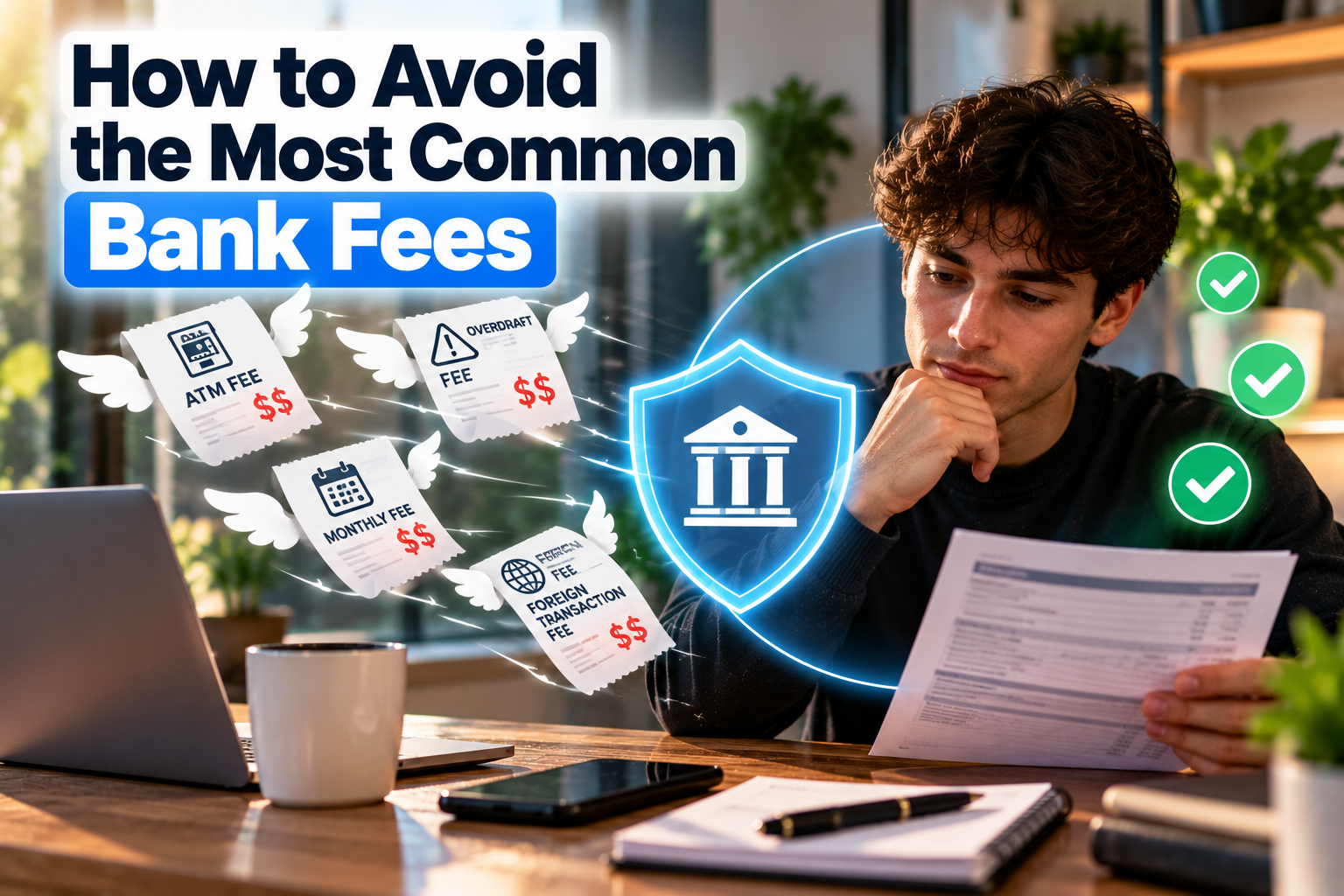
Fee examples below were checked on each bank’s website between October 15 and October 20, 2026.
Bank fees are easy to ignore because they’re small and spread out — a monthly fee here, an overdraft there. Over a year, they can add up to more than most savings accounts pay in interest. The good news is that nearly every common bank fee can be avoided. Here’s how.
Table of Contents
Monthly Maintenance Fees
Monthly maintenance charges are among the most common bank fees. Many traditional checking accounts charge one unless you meet certain conditions. For example, when we checked:
- Chase Total Checking: $15 a month, or $0 with $500 or more in qualifying electronic deposits, a $1,500 balance at the beginning of each day, or a $5,000 average beginning-day balance including linked accounts.
- U.S. Bank Smartly Checking: $12 a month, waived for account owners aged 13–24 or 65 and over, among other options.
- Regions 62+ LifeGreen Checking: $8 a month with online statements ($11 with paper), waivable with a $1,500 average balance or qualifying direct deposits.
How to avoid it: meet the waiver (direct deposit is usually the easiest), check whether your age qualifies you for a waiver, or switch to an account with no monthly fee. Many online banks — including Ally, Capital One 360 and SoFi when we checked — charge no monthly fee at all. See our best bank accounts guide.
Overdraft and Non-Sufficient Funds (NSF) Fees
An overdraft fee is charged when the bank covers a transaction you don’t have enough money for. An NSF fee is charged when it declines or returns a payment instead. The Consumer Financial Protection Bureau suggests four ways to avoid them:

ATM Fees
Using an out-of-network ATM can mean two bank fees: one from your bank and one from the ATM’s owner.
How to avoid them:
- Use your bank’s own ATMs or its fee-free network (many online banks use networks such as Allpoint).
- Choose an account that reimburses ATM fees. Alliant Credit Union, for example, rebates up to $20 a month, and Schwab Bank Investor Checking offered unlimited ATM fee rebates worldwide when we checked.
- Get cash back when you pay with your debit card at a store.
Paper Statement Fees
Some banks charge for mailed statements. TD Bank, for example, listed a $3 monthly fee for paper statements on some accounts, with exceptions for customers 60 and over. Switching to e-statements usually removes the fee — and some accounts require e-statements to earn their best rate.
Excessive Withdrawal Fees on Savings
Some savings accounts charge if you make too many withdrawals or transfers in a month. Ally, for example, has charged $10 per excess withdrawal after six in a statement cycle, according to a May 2026 review. Plan bigger, less frequent transfers, or keep money you move often in checking.
Foreign Transaction and Wire Fees
Using your debit card abroad can trigger a foreign transaction fee, often a percentage of each purchase. If you travel, look for an account with no foreign transaction fees (Schwab’s Investor Checking advertised none). For wires, compare fees before sending; some business accounts, such as Mercury, offered free domestic wires when we checked.
Minimum Balance and Inactivity Fees
Some accounts charge if your balance drops below a minimum or if you don’t use the account for a long time. Read the fee schedule, keep at least the minimum balance, and close accounts you no longer use — in writing.
A Five-Minute Fee Check
- Download your last three statements.
- Search for the word “fee.”
- For each fee, find out what triggered it and how to avoid it.
- Ask your bank to waive one-off fees, especially if you’ve been a long-time customer.
- If you keep paying a monthly fee you can’t avoid, consider switching banks.
Bottom Line
Most bank fees are optional if you know the rules: meet or avoid monthly fee requirements, don’t opt in to debit card overdrafts, stay in your ATM network and switch to e-statements. If your bank still charges you every month, a no-fee account elsewhere is usually the simplest fix.
This article is for informational purposes only and is not financial advice. BankNavigatorr has no affiliate relationships with any bank and is supported by advertising.