
Requirements checked against SBA, IRS and FinCEN sources on October 20, 2026. Banks can ask for more than the minimum, so confirm the list with the bank you choose.
Knowing how to open a business bank account is one of the first practical steps after starting a business. A dedicated account keeps your business money separate from your personal money, makes taxes and bookkeeping easier, and lets customers pay your business directly. This guide walks through what you need and how to do it.
Table of Contents
Why Open a Separate Business Account?
The U.S. Small Business Administration recommends opening one “when you’re ready to start accepting or spending money as your business,” according to its business guide. A separate account helps you:
- Protect yourself: keeping business and personal funds apart supports the liability protection of an LLC or corporation.
- Stay organized: every business income and expense is in one place at tax time.
- Look professional: customers can pay your business by card, check or transfer.
- Build business credit: many banks offer business credit cards and credit lines to account holders.
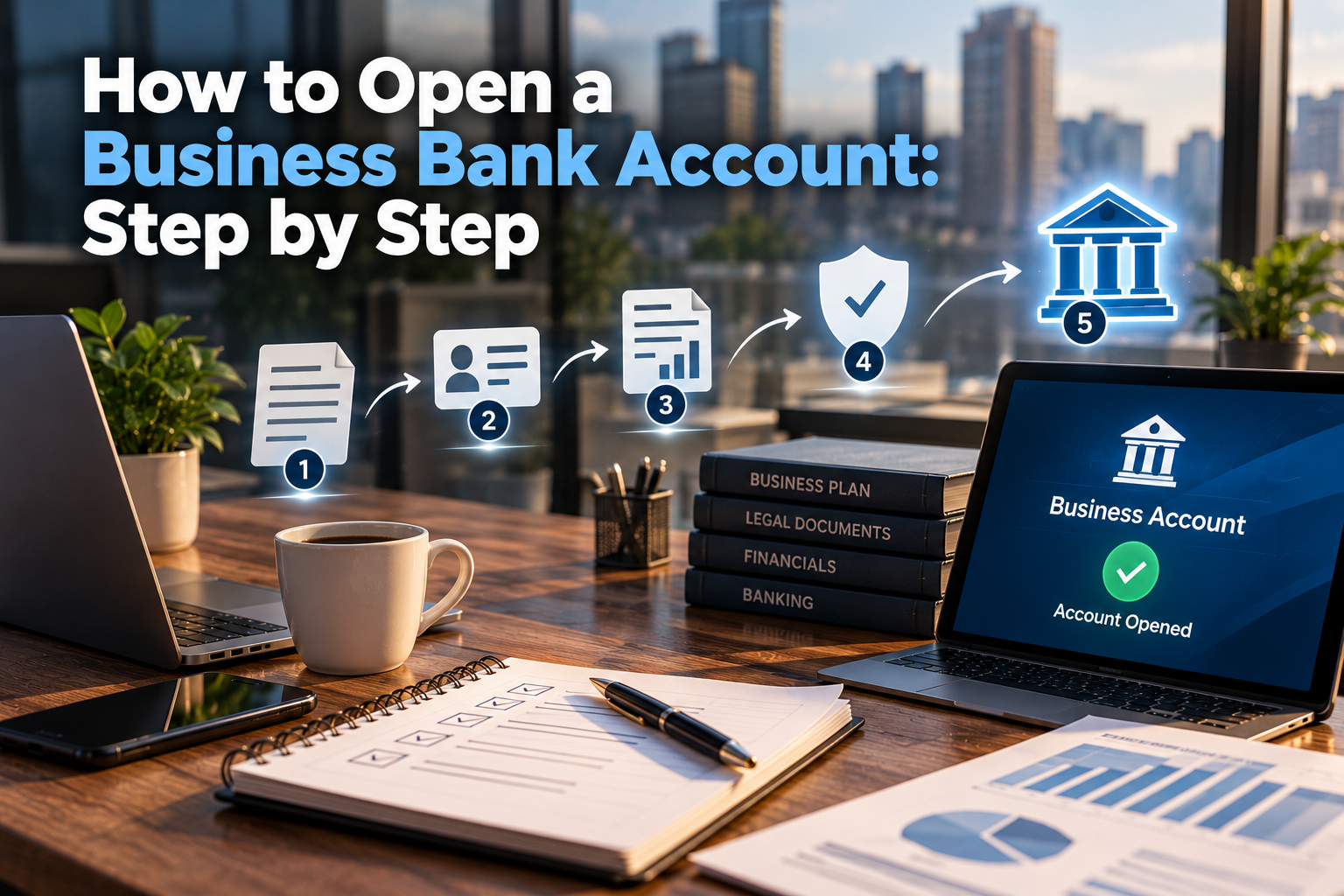
Step 1: Get Your Business Identification Ready
Most banks ask for a federal Employer Identification Number (EIN). The SBA notes that sole proprietors can often use their Social Security number instead, but many still get an EIN to avoid sharing their SSN with clients.
You can get an EIN directly from the IRS, online and for free. If you’re approved, the number is issued immediately. Keep in mind:
- The IRS says you “never have to pay a fee for an EIN.” Avoid websites that charge for it.
- The online application must be finished in one session.
- If you’re forming an LLC or corporation, register it with your state first.
Step 2: Gather Your Documents
According to the SBA, banks commonly ask for:
| Document | Who usually needs it |
|---|---|
| EIN (or SSN for many sole proprietors) | Everyone |
| Formation documents (articles of organization or incorporation) | LLCs and corporations |
| Ownership agreements (operating agreement, bylaws or partnership agreement) | LLCs, corporations and partnerships |
| Business license | Businesses that need one in their city, county or state |
| Government-issued photo ID | Every owner and authorized signer |
If you operate under a name that isn’t your legal name, banks may also ask for your “doing business as” (DBA) registration.
Why banks ask about owners
Under federal anti-money-laundering rules, banks must identify the “beneficial owners” of legal entities such as LLCs and corporations. According to FinCEN, that means each person who owns 25% or more of the business, plus one person with significant control, such as a CEO or managing member. Sole proprietorships are not covered by this requirement, so opening an account as a sole proprietor is usually simpler.
Step 3: Choose the Right Type of Account
The SBA lists the most common business accounts as checking, savings, credit card and merchant services accounts. For most new businesses, a business checking account comes first. Compare:
- Monthly fees and how to avoid them
- Transaction limits and per-item fees
- Cash deposits, if your business takes cash
- Wire and ACH fees
- Integrations with your accounting software and payment processor
- Interest on balances, if you keep reserves in the account
Online business banks often charge no monthly fee but can be limited for cash. Traditional banks make cash deposits easy but often charge a monthly fee unless you meet requirements. Our guides to the best business bank accounts and business accounts with no fees compare current options with fees checked on each provider’s site.
Step 4: Apply Online or at a Branch
Many banks and fintech platforms let you apply online in minutes. Some limit online applications to certain business types: when we checked, Chase allowed sole proprietorships, corporations and single-member LLCs to open its Business Complete Banking account online, but asked other structures to visit a branch.
During the application, expect to:
- Enter your business details (legal name, EIN, address, industry and formation date).
- Provide details and ID for each owner and authorized signer.
- Upload your formation and ownership documents.
- Make an opening deposit, if the account requires one.
Step 5: Set Up the Account Properly
- Order debit cards for anyone who needs one, with spending limits where possible.
- Connect your accounting software and payment processor.
- Move all business income and expenses to the new account — and stop using personal accounts for business.
- Consider a separate account or sub-account for taxes. Some business accounts let you create several.

Special Cases
- Nonprofits usually also need their IRS determination letter and a board resolution naming authorized signers. See our nonprofit banking guide.
- Startups and multi-member LLCs may need every owner to verify their identity before the account is approved. See our startup banking guide.
- Large balances: business deposits are FDIC-insured up to $250,000 per depositor, per bank, per ownership category. Some platforms offer more through sweep programs. Our guide to how FDIC insurance works explains the details.
Frequently Asked Questions
Do I need a business bank account as a sole proprietor?
It isn’t generally required, but it’s strongly recommended. It makes bookkeeping and taxes much easier and helps show which transactions are business expenses.
Can I open a business account without an EIN?
Many banks let sole proprietors use their SSN. LLCs and corporations usually need an EIN.
How long does it take?
Online applications can be approved the same day if your documents are in order. Additional checks for multi-owner businesses can take longer.
Bottom Line
Get your EIN free from the IRS, gather your formation and ownership documents, and compare business accounts on fees, cash access and integrations before you apply. Then route every business transaction through the new account from day one.
This article is for informational purposes only and is not financial, legal or tax advice. BankNavigatorr has no affiliate relationships with any bank and is supported by advertising.